
IBSI is a multipurpose HTML5 template with various layouts which will be a great solution for your business.

Contact Info

Moonshine St. 14/05
Light City, London
[email protected]
00 (123) 456 78 90

Follow Us

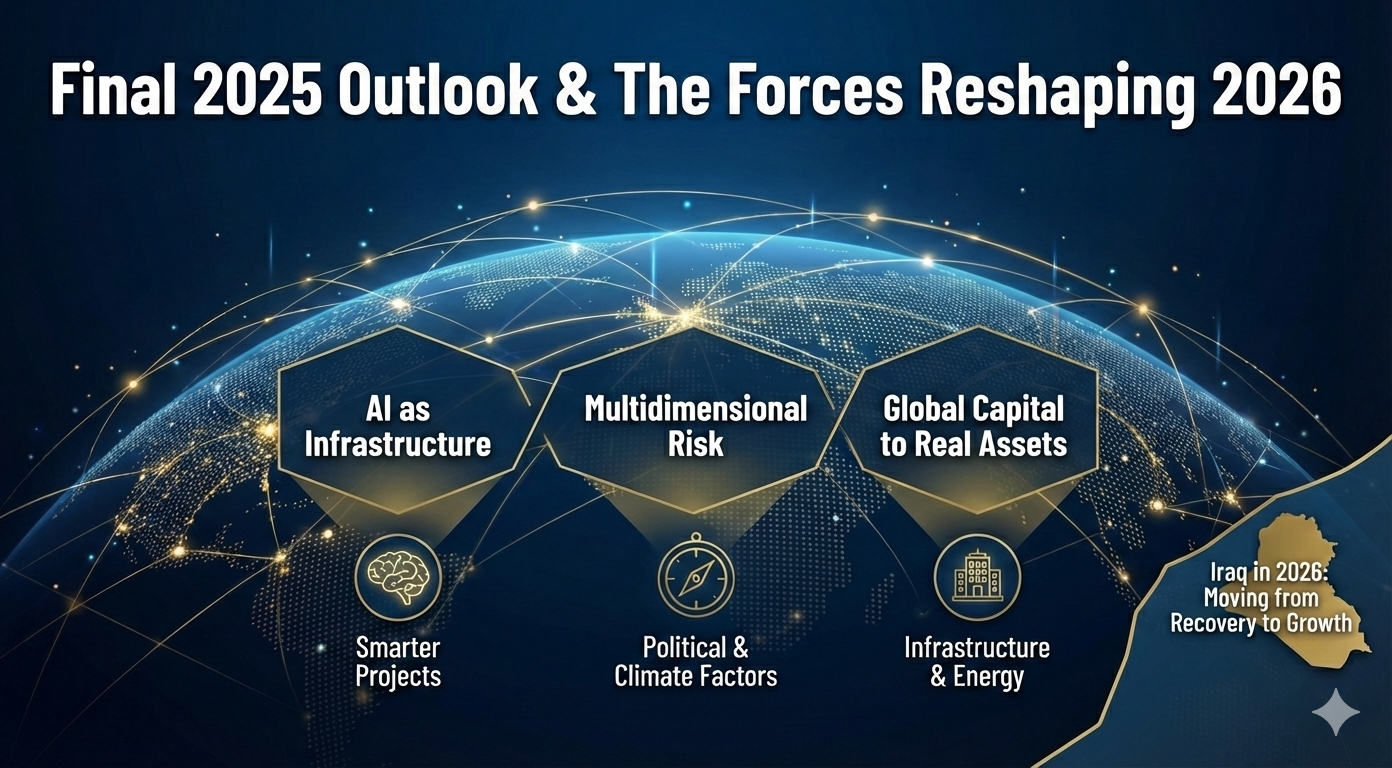
Final 2025 Outlook & The Forces Reshaping 2026

Key shifts in AI, risk, and global capital to guide your 2026 outlook

As we move toward the end of 2025, it’s clear that the global economy is entering a new phase. The past year hasn’t been defined by one single event. Instead, it’s been shaped by a combination of technology breakthroughs, shifting geopolitics, and changing investor priorities.

These are not short-term trends. They represent deeper structural changes that will influence how capital moves, how projects are built, and how economies grow in 2026 and beyond.

For emerging markets like Iraq, this moment matters. There is growing international interest, but success will depend on understanding where the world is headed and acting with clarity and purpose.

At IBSI, we see three forces driving this transition: artificial intelligence, a new way of thinking about risk, and a global shift toward real, productive assets.

AI is becoming infrastructure, not just technology

In 2025, artificial intelligence moved beyond being a “nice-to-have” tool. It is now becoming part of core infrastructure.

From energy systems and healthcare to logistics and finance, AI is increasingly embedded into how major projects are designed and operated. Investors are using AI-driven models to evaluate feasibility, forecast demand, and manage operational risks. Governments are adopting digital systems to improve planning and service delivery.

This matters because it changes how investment decisions are made.

Projects today are expected to be smarter from day one. Energy networks are becoming more efficient. Agriculture is moving toward precision farming. Hospitals are adopting digital platforms. Even housing developments are being designed with smart systems in mind.

For countries like Iraq, this creates an opportunity to skip older development stages and move directly into modern, technology-enabled infrastructure.

At IBSI, we already use AI-supported market analysis to help international partners identify scalable opportunities across energy, housing, healthcare, and agriculture.

Risk is no longer viewed the same way

Risk used to be mostly about interest rates and market cycles. That has changed.

Today, investors are also looking at political stability, regulatory clarity, climate exposure, cybersecurity, and supply-chain resilience. Risk has become multidimensional.

Instead of avoiding risk completely, global capital is learning how to measure it better and structure around it.

Several patterns are becoming clear:

  • Investors are diversifying geographically rather than concentrating in a few traditional markets.
  • Energy security is now a strategic priority, not just a commercial one.
  • Countries with improving investment laws and transparent processes attract more long-term capital.
  • Sustainable projects are gaining access to better financing terms.

Iraq fits into this evolving picture. The country now has investment commissions in every governorate, a National Investment Commission in Baghdad, and updated legal frameworks designed to support private-sector growth. These changes are helping rebuild investor confidence.

IBSI works closely with international partners to navigate this environment, ensuring projects are structured in line with today’s regulatory and risk expectations.

Global capital is moving back to the real economy

One of the biggest shifts heading into 2026 is where money is going.

After years of speculative investment, large institutions are returning to fundamentals: infrastructure, energy, housing, healthcare, education, and agriculture. These sectors offer steady demand, long-term returns, and tangible impact.

Capital is increasingly flowing into:

  • Power generation and renewable energy
  • Residential housing developments
  • Private hospitals and healthcare facilities
  • Agricultural production and food security
  • Education infrastructure
  • Commercial centers and logistics hubs
  • Construction materials and cement production

This trend strongly favors developing markets where infrastructure gaps are still wide and population growth supports future demand.

Iraq stands out here. With a young population and significant rebuilding needs, it offers one of the region’s most underdeveloped but promising investment landscapes.

IBSI helps bridge this gap by connecting international capital with reliable local execution.

Iraq in 2026: moving from recovery to growth

The coming year marks an important transition for Iraq.

The focus is shifting from stabilization to structured economic growth. Government reforms, updated investment laws, and sector-specific initiatives are opening opportunities across energy, housing, healthcare, agriculture, education, and industry.

Foreign investors now benefit from easier residency processes, improved visa systems, clearer capital transfer mechanisms, and better access to project pipelines.

Still, entering a market like Iraq requires trusted local guidance. Understanding regulations, building partnerships, and managing on-ground realities makes all the difference.

This is where IBSI plays its role.

How IBSI supports investors

IBSI works alongside international companies at every stage:

  • Identifying investment opportunities
  • Conducting market research and feasibility studies
  • Supporting financial structuring
  • Coordinating with government authorities
  • Building local partnerships
  • Assisting during project execution

Our team brings experience from legislation, banking reform, energy advisory, agriculture development, and private-sector capacity building. We combine global standards with deep local knowledge.

Simply put, we help investors move from idea to implementation.

Looking ahead

The forces shaping 2026 are already here.

AI is changing how projects operate. Risk is being evaluated differently. Capital is returning to real assets and emerging markets.

For those willing to plan carefully, work with the right partners, and focus on long-term value, the coming year offers meaningful opportunities.

At IBSI, we believe 2026 will favor builders, not speculators.

And the work starts now.

France in discussions on Baghdad Elevated Train (BET) Project

The Secretary-General of the Council of Ministers, Dr. Hamid Naim Al-Ghazi, met on Wednesday the French Ambassador to Iraq, Mr. Eric Chevalier.

Dr. Al-Ghazi stressed the Iraqi government’s interest in the Baghdad Elevated Train (BET) project, which he said is of vital and strategic importance.

Mr. Chevalier also expressed the French government’s interest in the project, and said the company [Alstom] was keen to hold meetings with the relevant authorities in Iraq to finalise the details.

Im 2020, an Alstom-led Consortium, together with its partner Hyundai Engineering & Construction, signed a Letter of Intent with the Iraqi Ministry of Transport to define a framework for all the appropriate steps to accelerate the implementation of the project.

The Baghdad Elevated Train Project is a 20 km elevated metro in Baghdad with 14 stations, and includes the supply of rolling stock, electromechanical systems, tracks, as well as associated civil works. The light rail system would link Al-Khadumia, AlEtafia, Alsarafia bridge Al-Mustansirya, Wazyria and AlShab over 16km, and AlEtafia AlMuthana airport to Al-Alawi over 4km.

(Source: General Secretariat for the Council of Ministers)

By John Lee (iraq-businessnews.com)

Iraq’s opens its first Hydrogen Production Unit

Iraq’s first hydrogen production and compression unit has been opened at the Ministry of Oil’s Oil Research and Development Centre.

The unit, which is for research purposes, can produce hydrogen with a purity of 99.5 percent, and compress it to 150 bar.

A statement from the Ministry said that this is sufficient to meet the needs of the research departments, with the surplus supplies being used by companies and state institutions.

At the opening, the Ministry’s advisor for energy affairs, Abdul Baqi Khalaf, said that Iraq is committed to its commitments regarding reducing gas emissions and pollutants and protecting the environment and climate.

(Source: Ministry of Oil)
By John Lee (iraq-businessnews.com)

GKP Profits more than Double

Gulf Keystone Petroleum (GKP) has today announced its results for the half year ended 30 June 2022.

Jon Harris (pictured), Gulf Keystone’s Chief Executive Officer, said:

“With the strengthening oil price and increased production, we have delivered strong profitability and cash flow generation in the first half of the year. As we progress towards approval of the Field Development Plan, we have continued to develop the Shaikan Field and recently resumed drilling with the spud of SH-16. We have paid a record $190 million of dividends in 2022 and are pleased today to announce an incremental interim dividend of $25 million, increasing total dividends declared this year to $215 million. While delivering a sector leading dividend yield, we have also maintained a strong balance sheet, redeeming our $100 million bond leaving the Company debt free.

“Looking ahead to the rest of the year, we are focused on progressing towards FDP approval and achieving our production and opex guidance as we continue to optimise production from the field while maintaining a rigorous focus on costs. We have raised our 2022 capex guidance to $110-$120 million as we have added the drilling of SH-16 and are progressing initial procurement activities for the installation of water handling facilities, which will enable us to unlock additional production from our wells in the future.

“We remain focused on balancing investment in growth with shareholder returns. Continued robust cash generation provides flexibility to consider funding future capital expenditures and further distributions to shareholders, while preserving adequate liquidity.”

Highlights to 30 June 2022 and post reporting period:

Operational

  • Strong safety performance, with no Lost Time Incident (“LTI”) recorded for 315 days
  • 2022 year to date gross average production increased by 3.6% to c.45,000 bopd as compared to the FY 2021 average of 43,440 bopd
  • Continued to progress delivery of our 2022 work programme:
  • Resumed drilling activities late August with the spud of SH-16

Financial

  • Free cash flow more than doubled to $177.3 million (H1 2021: $66.7 million), driven by the strengthening oil price and continued production growth, enabling the Company to deliver against its strategic commitment of balancing investment in growth with shareholder returns
  • Dividends declared of $215 million in 2022, providing shareholders with a sector-leading dividend yield of 36% based on GKP’s closing price on 30 August 2022
  • Significant increase in Adjusted EBITDA and profitability in H1 2022:
  • Net capex of $41.8 million (H1 2021: $14.1 million), primarily related to the drilling of SH-15, well interventions and workovers, well pad construction, procurement of flowlines and plant expansion activities
  • $354.4 million net to GKP received year to date from the Kurdistan Regional Government (“KRG”) for crude oil sales and revenue arrears, with the arrears balance related to the November 2019 to February 2020 invoices fully recovered
  • $100 million outstanding bond redeemed in August, leaving the Company debt-free and eliminating annual interest costs of $10 million
  • Robust balance sheet maintained with cash balance of $112.0 million at 31 August 2022

Outlook

  • 2022 gross average production guidance reiterated at 44,000-47,000 bopd
  • Gross Opex guidance of $2.9-$3.3/bbl remains unchanged
  • Increasing 2022 net capex guidance from $85-$95 million to $110-$120 million
  • While timing of Field Development Plan (“FDP”) approval remains uncertain, we continue to engage with the Ministry of Natural Resources (“MNR”) towards project sanction and are progressing the tendering process for the Gas Management contract. We are also monitoring the potential impact of global supply chain pressures and logistical challenges on the costs and schedule of the FDP
  • We continue to monitor the long running dispute between the Federal Iraqi Government and the KRG on the management of oil and gas assets in Kurdistan. Our operations currently remain unaffected

Shareholder Distributions

  • The Company has announced an ordinary dividend policy of at least $25 million per year and, with free cash flow, is committed to maximising distributions taking into account various factors, including investment levels required to achieve production targets, deliver profitable growth and satisfy PSC obligations, and preserve adequate liquidity to manage geopolitical, KRG payment and market uncertainties
  • Today we are declaring an interim dividend of $25 million, increasing total dividends declared in 2022 to $215 million:
  • Assuming timely payment of invoices and continuing strong oil prices, we expect continued robust cash flow generation, which would provide flexibility to consider funding future capital expenditures and further distributions to shareholders, while preserving adequate liquidity
  • With continued progress towards implementing the FDP, the Company expects to firm up the future estimated timing and levels of investment and review the dividend policy